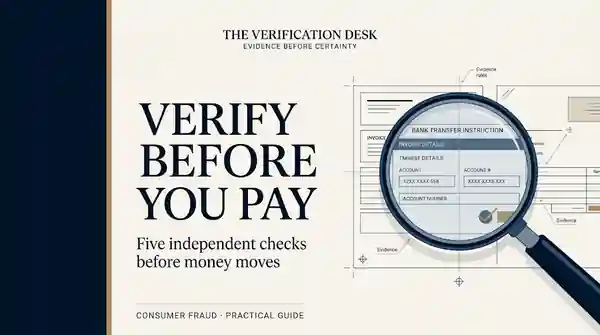
The safest time to verify a payment is before the money moves.
CLAIM
A convincing invoice, message or telephone call is enough to justify payment.
EVIDENCE
Scam communications increasingly reproduce genuine brands, names and business language. The NCSC warns that attackers use pressure and trust to make people act quickly. Surface quality is therefore a weak test: a polished document can still contain a false destination.
TEST
A proposed payment should survive checks that do not depend on the instruction itself.
VERDICT
Verify the transaction, the recipient and the route independently. One matching detail is not enough.
ACTION — FIVE CHECKS BEFORE PAYMENT
1. Authority
Does the person requesting payment have the authority to do so? Verify through the normal approval route. A senior name in an email header does not establish authority.
2. Obligation
What is the payment for? Match the request to a contract, purchase order, verified invoice or other underlying obligation. Check quantity, amount, date and supplier identity.
3. Destination
Are the bank details already verified? Any change requires independent confirmation using pre-existing contact information.
4. Identity
Confirm the counterparty through a reliable source independent of the message. Check the complete domain and telephone number, not merely the display name or logo.
5. Context
Does the transaction make sense? Look for unusual urgency, secrecy, payment method, timing, value, beneficiary country or departure from established practice.
THE TWO-CHANNEL RULE
When risk is material, verify through a second channel that the requester did not provide in the same communication. If the request arrives by email, use a known telephone number or internal workflow. If it arrives by telephone, verify through a trusted written route.
STOP CONDITIONS
- The requester resists verification.
- The payment destination has changed unexpectedly.
- The instruction demands secrecy.
- The request sits outside the normal commercial relationship.
- The evidence cannot be reconciled to existing records.
IF UNCERTAIN
Do not allow a deadline manufactured by the requester to replace your control process. Escalate internally or contact the relevant financial institution using trusted details.
Evidence & official sources
The Verification Desk distinguishes verified fact, evidence-led inference and unresolved uncertainty. This publication provides general information, not legal, financial, regulatory or emergency advice. Findings reflect the evidence available at publication and may be updated if material evidence changes.

Leave a Reply