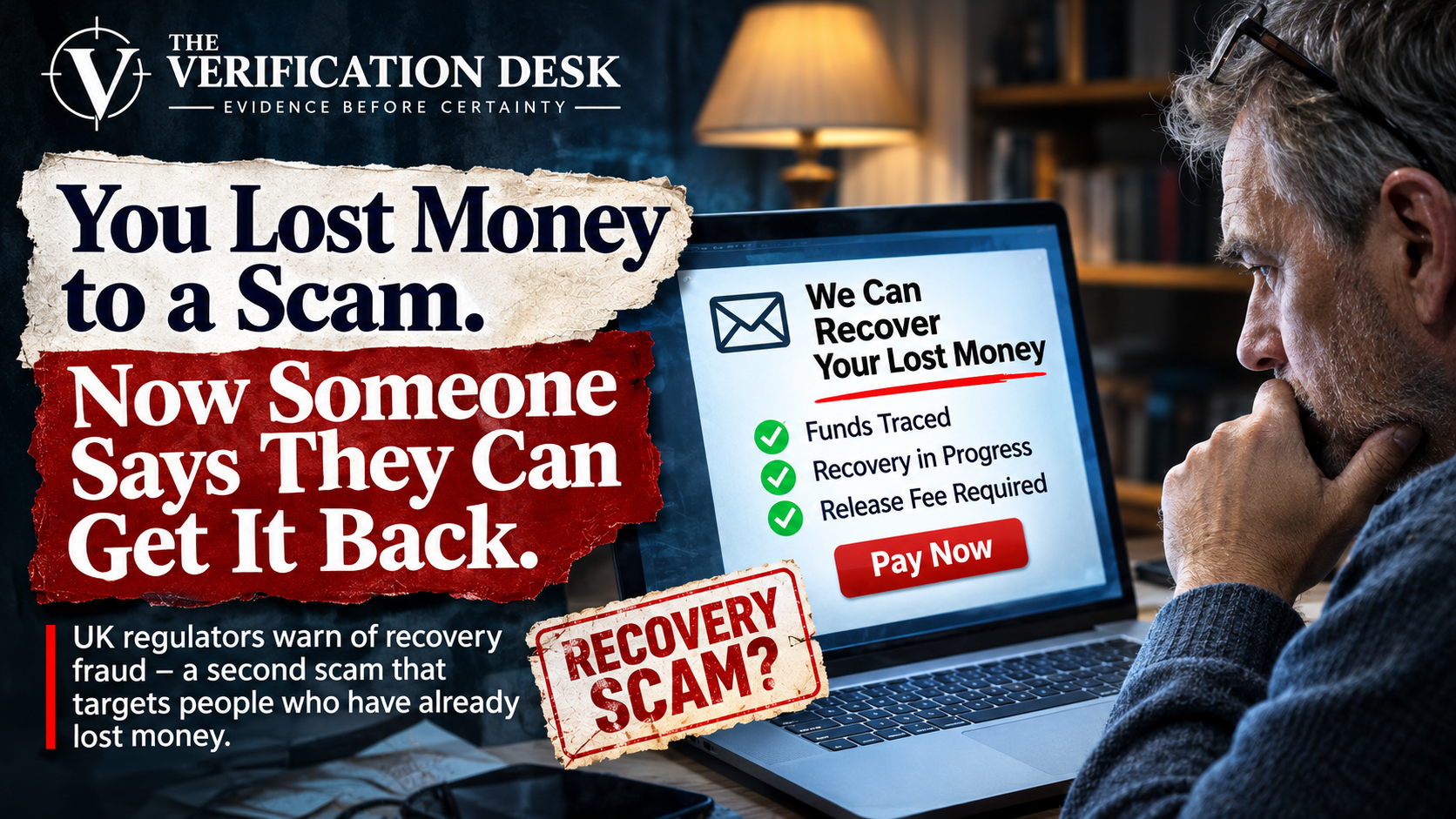
The second approach may be more convincing than the first. UK regulators warn that criminals target people who have already lost money, sometimes using information about the original fraud.
The money is gone. Then someone contacts you claiming it has been traced and can be returned after a tax, legal or administration payment. This opening is illustrative, not a report about an identified victim.
CLAIM
Criminals approach previous fraud victims offering to recover lost money, often demanding an advance fee. This broader recovery-fraud mechanism is not confined to impersonation of the FCA.
EVIDENCE
The Financial Conduct Authority describes ‘recovery room scams’, often following investment fraud. Its guidance, updated 19 January 2026, explains that original offenders may reapproach victims under another identity or information about victims may be passed to other criminals. Report Fraud separately warns of recovery fraud involving purported officials, legal organisations and advance fees. Knowing details of the original loss does not establish the caller’s authority.
TEST
Was the approach unsolicited? Does the caller know details that might have been obtained through the original scam? Is a fee demanded before supposedly recovered money can be released? Is official authority claimed but not independently verifiable? A credible-looking document or familiar company name is not enough. Where relevant, verify a financial firm’s authorisation, permissions and contact details independently using the FCA Firm Checker.
VERDICT — V5 VERIFIED
The documented recovery-fraud mechanism is verified by the FCA and Report Fraud. The available guidance does not establish the percentage of recovery scams committed by the original fraudsters, a precise current nationwide loss total for this technique, or whether any particular unsolicited offer is fraudulent.
ACTION
- Do not pay an unsolicited recovery fee before independently establishing the organisation’s identity and authority.
- Contact your bank or payment provider directly about reimbursement and recovery options.
- Check relevant firms through the FCA Firm Checker using independently obtained contact details.
- Keep messages, payment records and documents. If you have paid a suspected fraudster, contact your bank promptly.
- Report suspected fraud to Report Fraud in England, Wales and Northern Ireland, or Police Scotland in Scotland.
Someone knowing how much you lost is not evidence that they know how to get it back.
Evidence Before Certainty.
Sources
- Financial Conduct Authority — Recovery room scams
- Report Fraud — Recovery fraud
- Financial Ombudsman Service — Fraud and scams
Related TVD investigation: Scammed Once? The Next Caller May Pretend the FCA Has Recovered Your Money.
