Category: Business & Professional Scams

  • The Trademark Email That Says Someone Else Is About to Take Your Business Name

    VERDICT: VERIFIED (V5)

    The message sounds like professional legal correspondence: somebody else is supposedly about to register your business or brand name, but you have one last chance to act first.

    CLAIM

    Businesses are receiving trademark approaches that misuse the identities or regulatory details of genuine solicitors and firms.

    EVIDENCE

    The Solicitors Regulation Authority (SRA) has issued repeated alerts during 2026 describing closely similar approaches. The emails tell recipients that a third party has approached the sender to register the recipient’s UK brand or company name and seek exclusive rights. The recipient is then invited to secure trademark registration first, with the sender offering assistance.

    SRA alerts dated 8 April, 7 May, 13 May, 16 June, 13 July, 16 July, 19 August, 9 September and 10 September 2026 document variants misusing names or details associated with genuine solicitors or firms.

    TEST

    The repetition across separate SRA alerts establishes the recurring method. It does not establish that every approach came from one criminal group, and TVD makes no such attribution.

    VERDICT

    V5 — Verified.

    How to prevent it

    • Do not treat an SRA number or a genuine solicitor’s name as proof that the sender is that person.
    • Look up the solicitor or firm independently using the SRA’s official records and use independently obtained contact details.
    • Do not use the telephone number, email address or website supplied in the unexpected message to perform that verification.
    • If a trademark issue may be genuine, verify it independently before paying or instructing anyone.

    Warning signs

    • An unsolicited legal-looking email says somebody else is about to register your business or brand name.
    • You are pressured to instruct the sender immediately to protect the name.
    • The sender uses genuine-looking solicitor or SRA details but contact information does not match independently verified records.

    What to do if you responded

    Stop further payment or correspondence until the sender has been independently verified. If you paid, contact your bank. If you supplied account credentials, secure them. Preserve the original email, headers, attachments and payment instructions.

    Where to report it

    Check and report suspected solicitor impersonation through the SRA’s official channels and use the appropriate fraud-reporting route if money was lost. See Fraud First Aid.

    Sources: Solicitors Regulation Authority scam alerts published throughout April–September 2026.

    Evidence boundary: genuine solicitors and firms named in SRA alerts are victims of identity/detail misuse; TVD does not suggest they participated in the scam.

  • Car-Finance Claim Messages: Verify Before You Respond

    Car-Finance Claim Messages: Verify Before You Respond

    A message about a car-finance claim can look plausible, timely and professional. None of those things proves who sent it.

    On 22 September 2026, the Financial Conduct Authority added www.approvedcarclaim.com and www.pcp.ashley-howard.co.uk / www.ppi.ashley-howard.co.uk to its Warning List. In each warning the FCA states that the firm is not authorised by it and may be targeting people in the UK.

    The important consumer lesson is broader than any one website: when a subject is already receiving widespread public attention, a message that appears topical can feel credible before its identity has actually been checked.

    CLAIM

    If a message correctly refers to car-finance compensation or PCP claims, the sender is probably a legitimate claims or financial-services business.

    EVIDENCE

    The FCA’s Warning List shows that unauthorised firms can operate in the same subject areas consumers are actively searching for. The regulator also warns that firms may provide contact details belonging to another business or individual so that an approach appears genuine.

    TEST

    Before clicking, replying or providing personal details, separate the subject of the message from the identity of the sender.

    1. Do not use the link in the message to verify the sender. Search independently.
    2. Check the exact legal or trading name. Similar names are not the same identity.
    3. Use the FCA Firm Checker where regulated activity is involved. Compare the contact details shown there with the ones used to approach you.
    4. Do not assume an existing car-finance relationship authenticates a new claims company.
    5. Be cautious with requests for identity documents, bank details, fees or authority to act. Establish who you are dealing with first.

    VERDICT: V1 VERIFIED

    The FCA added car-finance and PCP-related websites to its Warning List on 22 September 2026. That is verified primary-source evidence that consumers should independently check the identity and regulatory status of businesses approaching them about this subject.

    It does not follow that every unsolicited car-finance claim message is fraudulent. The correct response is verification, not assumption.

    ACTION

    If you receive a car-finance compensation message, preserve it before deleting anything. Record the sender, telephone number, email address, website and any company or FCA reference numbers supplied. Then verify those details independently.

    If the approach involves a firm on the FCA Warning List, follow the FCA’s guidance and avoid dealing with it.

    Primary sources: FCA Warning List; FCA warning: www.approvedcarclaim.com; FCA warning: www.pcp.ashley-howard.co.uk / www.ppi.ashley-howard.co.uk.


    The Verification Desk distinguishes verified fact, evidence-led inference and unresolved uncertainty. Mention of a website or firm reflects the cited FCA warning and is not an independent finding of criminal conduct. This publication provides general information, not legal or financial advice.

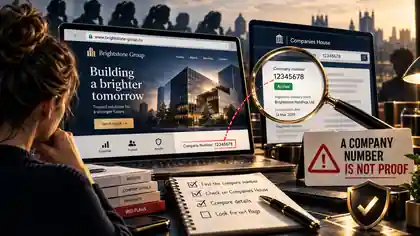
  • A Company Number Is Not Proof: How to Verify a Business Website

    A Company Number Is Not Proof: How to Verify a Business Website

    A company number can be genuine while the website displaying it is not.

    On 23 September 2026, the Financial Conduct Authority published a warning about MyCarSecurity.com. The FCA stated that the unauthorised firm had no association with Tide Group Holdings Ltd and was falsely claiming the genuine UK company’s registered number.

    That example demonstrates an important verification principle: finding a real company number is only the beginning of a check, not the end of it.

    CLAIM

    If a website displays a company number that exists at Companies House, the website has proved that it belongs to that company.

    EVIDENCE

    The FCA warning provides a current example where a genuine registered company number was, according to the regulator, being used by an unauthorised firm with no association to the genuine company.

    A registration record can establish that a company exists. It does not automatically establish that the website, email address, telephone number or bank account you are dealing with is controlled by that company.

    TEST

    When a website gives you a company number, cross-check the identity rather than merely confirming that the number exists.

    1. Search the number independently. Enter it yourself into Companies House rather than following a supplied link.
    2. Compare the legal name. Does the registered company name match the business identity being presented?
    3. Compare contact details. Check addresses, telephone numbers and email domains against reliable independent sources.
    4. Check regulatory status where relevant. For financial services, use the FCA Firm Checker or Financial Services Register independently.
    5. Verify payment instructions separately. A matching company number does not authenticate a bank account.

    VERDICT: V1 VERIFIED

    The proposition that a company number alone proves the identity of a website is unsupported. The FCA’s 23 September warning provides primary-source evidence of a genuine registered number allegedly being used by an unrelated unauthorised firm.

    The correct conclusion is narrower: a company number can help identify a registered entity, but the connection between that entity and the website or person contacting you must be verified separately.

    ACTION

    If a website is asking for money, financial information or identity documents, do not treat a Companies House number, padlock icon or polished website as authentication. Cross-check the business through independent sources and contact it using details obtained independently.

    Primary sources: FCA: MyCarSecurity.com warning; FCA: How to check a firm or individual is authorised.


    The FCA warning concerns the entity and website identified in the FCA notice. The Verification Desk has not independently determined the conduct of any individual. This publication provides general information, not legal or financial advice.

  • Debt Help or Sales Funnel? Four Red Flags Before You Agree

    Debt Help or Sales Funnel? Four Red Flags Before You Agree

    Debt problems create urgency. That urgency can also make people easier to pressure.

    On 22 September 2026, the Financial Conduct Authority warned consumers to watch for red flags when seeking debt advice. The regulator said some people are being steered towards fee-paying debt solutions that may not suit their circumstances, sometimes through high-pressure sales tactics, misleading information or advisers without the appropriate permissions.

    CLAIM

    A persuasive debt-help advert, telephone call or WhatsApp conversation is enough to show that the advice is legitimate and suitable.

    EVIDENCE

    The FCA’s warning lists four red flags. The first is pressure tactics: being hassled or repeatedly contacted, particularly after an online enquiry or unexpected phone call, and being pushed to agree quickly over the phone or WhatsApp. The second is changing details: being asked or encouraged to alter income or outgoings on a form, or being coached on what to say. The third is failing to disclose, or discouraging, fee-free alternatives: being steered towards a fee-charging solution, such as an Individual Voluntary Arrangement or some debt management plans, without other options being properly explained first. The fourth is unclear identity: the person contacting you does not say who they work for, or their details do not match the firm’s official details.

    The FCA’s separate consumer guidance adds that firms which direct people to IVA websites are known as lead generators, and that they are not authorised to provide debt advice. It also says that adverts for IVAs do not always make clear that large fees are involved.

    TEST

    Before agreeing to a debt solution, run five independent checks.

    1. Identify the firm. Get its full legal name and contact details. Do not rely on the name displayed in a message or advert.
    2. Check authorisation independently. Use the FCA Firm Checker rather than a link supplied by the person contacting you.
    3. Ask what alternatives exist. A recommendation should not become a one-option sales pitch.
    4. Do not alter facts to qualify. If you are encouraged to change income, expenditure or other answers to fit a product, stop.
    5. Slow the decision down. Urgency is not evidence that a solution is right for you.

    VERDICT: V1 VERIFIED

    The FCA warning is current primary-source evidence. Pressure, coached answers, unclear identity and failure to explain alternatives are recognised red flags. Their presence does not by itself prove fraud, but it is sufficient reason to stop and verify independently before entering a debt solution.

    ACTION

    If you need debt help, use an independent route to find assistance. The FCA directs consumers to MoneyHelper for information on free, impartial debt advice and recommends checking firms through the FCA Firm Checker.

    If you believe you have been pressured into an unsuitable solution, preserve the advert, messages, telephone numbers, dates and documents you received. Do not rely only on screenshots: retain the surrounding context wherever possible.

    Primary sources: FCA: Debt advice warning: spot the red flags; FCA: Unauthorised or unsuitable debt advice.


    The Verification Desk distinguishes verified fact, evidence-led inference and unresolved uncertainty. This publication provides general information, not legal or financial advice. Findings reflect the evidence available at publication and may be updated if material evidence changes.

  • The Bank-Detail Change Verification Test

    The Bank-Detail Change Verification Test

    A request to change supplier bank details may be genuine. The email containing it proves almost nothing.

    CLAIM

    A bank-detail change should be treated as a change to a control, not an ordinary administrative instruction.

    EVIDENCE

    Compromised email accounts and convincing impersonation can place a fraudulent instruction inside a genuine conversation. Familiar wording, a correct signature block and knowledge of an invoice do not establish that the payment destination is legitimate.

    TEST

    The decisive test is independent confirmation through a channel already trusted before the change request arrived.

    VERDICT

    No independent confirmation, no change. Urgency is a reason to slow the process down, not bypass it.

    ACTION: THE BANK-DETAIL CHANGE TEST

    1. Freeze the change. Do not amend the supplier record or release payment.
    2. Use a pre-existing contact. Call a known contact using a number from the existing contract, verified supplier master record or official website, not the message requesting the change.
    3. Ask open questions. Confirm the change, effective date, reason and account name without reading every detail from the request.
    4. Require dual approval. One person verifies; another approves the amendment.
    5. Record the verification. Date, time, person contacted, number used, questions asked and outcome.
    6. Notify the known contact. Send confirmation to the previously established address as well as any new address.
    7. Control the first payment. For material changes, consider an independently approved test payment or enhanced review under the organisation’s policy.

    RED FLAGS

    • Pressure to act before a deadline
    • A request to avoid the usual contact
    • A new domain, subtle spelling variation or reply-to address
    • An explanation involving an audit, frozen account or confidential transaction
    • A simultaneous change to contact and bank details
    • Resistance to established verification controls

    IF PAYMENT HAS ALREADY BEEN MADE

    Contact the bank immediately through a trusted channel. Preserve the request, full email headers, invoice, payment approval, supplier record and every verification attempt. Contact the genuine supplier using established details.

    CONTROL TEMPLATE

    Change requested: ______
    Existing trusted contact: ______
    Independent number/source: ______
    Confirmed by: ______
    Verified by: ______
    Approved by: ______
    Date/time: ______
    First-payment control: ______

    Evidence & official sources


    The Verification Desk distinguishes verified fact, evidence-led inference and unresolved uncertainty. This publication provides general information, not legal, financial, regulatory or emergency advice. Findings reflect the evidence available at publication and may be updated if material evidence changes.